The stack runs over computing that each resource owner makes available under its own policies, from campus research computing and the state data center to national resources and the servers or cloud accounts participants bring, each in its own isolated tenant.
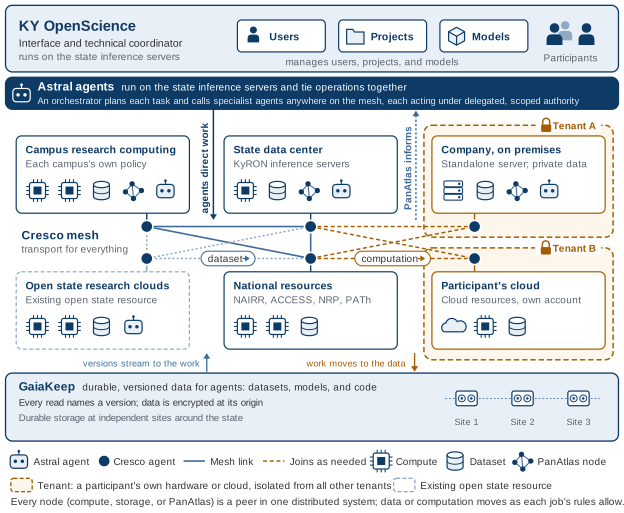
The foundation: links isolated resources into one secure mesh and moves data or computation under each site’s access controls.
Keeps datasets, models, and code as versioned, citable collections, encrypted at their origin, over the mesh.
Six open-source platforms, packaged as one toolkit, for language, vision, audio, time series, classification, and protocol-driven messaging.
LLM Factory
PlatformSelf-service platform for open-weight language models through a web chat interface or an OpenAI-compatible API, with private adapter training.
Vision Foundry
PlatformPlatform for training and deploying foundation vision models with self-supervised learning on Vision Transformers, for unlabeled or hard-to-label images.
Audio Foundry
PlatformSecure, web-based transcription platform with speaker labeling, timestamps, summarization, and theme extraction. Previously CAT-Talk.
Forecaster
PlatformWeb platform for time-series forecasting with multiple models and language-model-assisted interpretation, no programming required.
CLASSify
PlatformNo-code web platform for training, comparing, and explaining classification and clustering models on tabular data, with synthetic data generation.
SmartState
PlatformOpen-source protocol-driven messaging platform whose deterministic state machines keep every protocol on its path, with conversational interaction.
An orchestrator plans each task and calls specialist agents and the toolkit, each acting under the participant’s delegated authority.
Specifications are carried out with GitHub Spec Kit, GitHub’s open-source (MIT) toolkit for specification-driven development, which turns each specification into a plan and tasks under a governing constitution, so every agent action is reviewable before it runs and attributable afterward.
A distributed system that runs directly on Cresco: every PanAtlas instance, wherever it is hosted, is a node on the mesh. It sits beside the stack and is connected in both directions to the toolkit and the agents: the work they do generates new information that PanAtlas records, and PanAtlas provides what is known back to them.